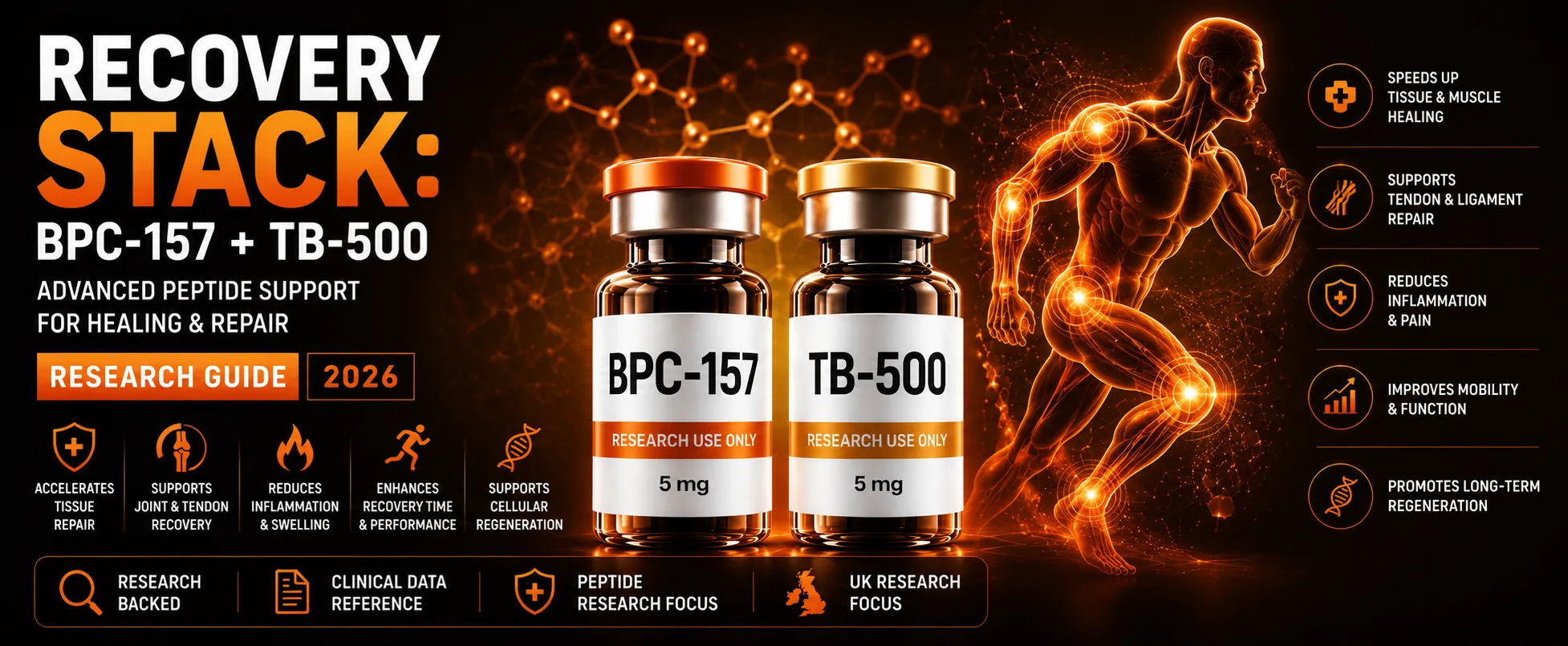
Recovery Stack
Combine BPC-157 and TB-500 to target complementary phases of the tissue repair cascade — angiogenesis and structural remodelling.
Add Recovery Stack to cart
Choose your strength for each peptide. Stack discount applied automatically.
Mechanism
How these two peptides work together in research models.
BPC-157 (Body Protection Compound-157) drives angiogenesis and upregulates growth factors including VEGF and TGF-β, building the vascular infrastructure needed for tissue repair.
View productTB-500 (Thymosin Beta-4) facilitates actin-mediated cell migration and stem cell recruitment, enabling cellular execution of the repair program.
View productBPC-157 (Body Protection Compound-157) drives angiogenesis and upregulates growth factors including VEGF and TGF-β, building the vascular infrastructure needed for tissue repair. TB-500 (Thymosin Beta-4) facilitates actin-mediated cell migration and stem cell recruitment, enabling cellular execution of the repair program. Together they address distinct but converging pathways in the healing cascade.
Research Rationale
BPC-157 upregulates angiogenic growth factors (VEGF, TGF-β) to build vascular infrastructure — TB-500 provides the actin-binding platform for cell migration into the repair site
BPC-157 modulates nitric oxide synthesis and protects endothelial integrity, while TB-500 regulates inflammatory signalling and reduces oxidative stress
The two peptides target separate phases of tissue repair: BPC-157 drives early-stage angiogenesis and granulation, TB-500 supports later-stage matrix remodelling
Each compound is individually vialled and batch-traceable with independent COAs — stack at your chosen concentrations
Research Applications
This stack is used in laboratory models of soft tissue repair, wound healing assays, endothelial cell migration studies, and inflammation-modulation research. Typical in vitro models include fibroblast scratch assays, endothelial tube formation assays, and macrophage polarisation studies.
FAQs
Other stacks